

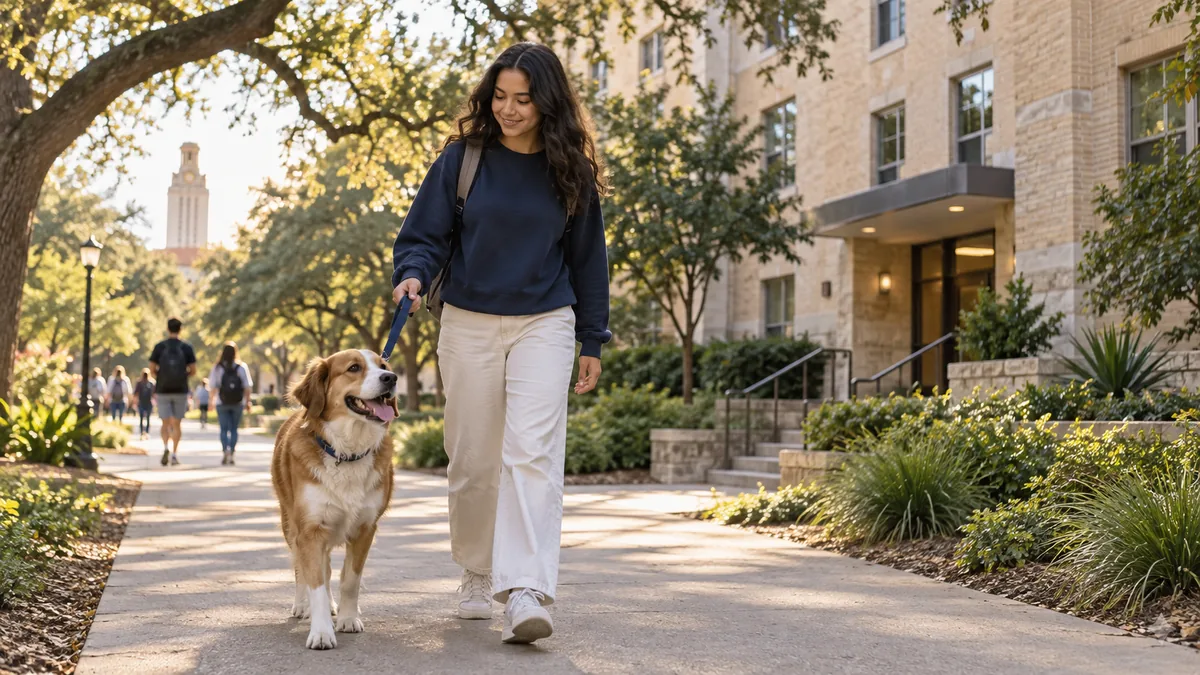
Campus housing has its own process. Here is how students can prepare a Texas college housing request and understand the role of an individual provider evaluation.
Can an ESA live in a Texas college dorm?
Students may request an accommodation through their campus housing or disability-services office. The school reviews the request under the rules and procedures that apply to its housing.
Housing rights differ from public access
An assistance-animal housing request is different from ADA public access. An ESA letter does not give an animal general access to classrooms, dining halls or other public spaces.
A provider makes an independent clinical decision, and a housing provider makes its own accommodation decision.
How a request usually works
Find the current campus policy, submit the student request, provide reliable supporting information when needed, respond to clarification questions and follow any campus animal requirements after a decision.
What documentation may address
When a disability-related need is not obvious, the school may request reliable information relevant to the accommodation. A provider evaluation considers individual needs and does not guarantee that a school will approve a request.
UT Austin and Texas A&M use school-specific procedures
Check directly with UT Austin or Texas A&M housing and disability-services offices for current forms, deadlines and submission instructions. A clinical evaluation and campus review are separate steps.
Start with the campus process
Contact the school’s disability-services or housing-accommodation office and ask which office handles assistance animals in residence halls. Review its current forms, documentation guidance, submission channel and deadlines before arranging records or an evaluation. Each school sets its own process within applicable requirements, so another student’s experience or an old online checklist may not match the current policy.
Plan for separate decisions
A clinical provider evaluates an individual’s needs and may prepare supporting documentation when appropriate. The school then reviews the accommodation through its own process. These are separate decisions and neither step guarantees the other. Ask whether the school needs a provider form, letter, interview or additional information, and allow time for both the evaluation and institutional review.
Housing is different from public access
A request to keep an assistance animal in campus housing is not a general right to take the animal into classrooms, dining areas or other public settings. ADA public-access rules use a different standard for trained service dogs. Students are responsible for checking campus rules for animal care, control, vaccinations, roommates and shared spaces while a request is reviewed.
Build enough time into the campus process
Campus accommodation reviews and clinical evaluations are separate steps, and each can take time. Check the school’s current submission deadline and ask whether an active housing contract is required before review. Do not assume that an ESA letter or PSD letter from the provider alone reserves a room or authorizes an animal to move in.
Ask which records the school needs
Some schools provide their own forms or request information from a licensed provider. Ask the disability-services office how to submit documents, whether the provider must complete a school form, and how the school will communicate its decision. Send records only through the channel identified by the institution.
Plan for roommates and shared spaces
If an accommodation is approved, follow the school’s current rules about animal care, control, sanitation, roommates and shared residential areas. Ask the housing office what applies to your building. These responsibilities are separate from the provider’s clinical evaluation and are not created or waived by an ESA letter or PSD letter.
Keep campus and community access separate
Approval for an animal in campus housing does not automatically authorize access to every classroom, dining facility, athletic venue or public space. The rules for housing and the ADA rules for public access are different. Check with the relevant office before bringing an animal into a setting beyond the approved residence.
Check school-specific forms and deadlines
Before you schedule or submit records, ask the school whether an active housing contract is needed, which office accepts the request, whether a school form is required, and what review or move-in deadlines apply. UT Austin and Texas A&M publish separate processes; use their current instructions rather than a general checklist. A campus decision is separate from a clinical evaluation.
General educational information only; not legal or medical advice. Rules and outcomes depend on the applicable law and individual facts.